
Semi-Automatic vs Automatic Bucket Filling Machines: When to Automate?
A bucket filling operation can use one of four configurations: a semi-automatic filling machine, a semi-automatic filling and lidding machine, an automatic rotary machine…


Bucket filling machines fill liquid and viscous products, with or without particles, into pre-made plastic buckets, tubs and similar containers. They can run on their own or as part of a complete packaging line. On a line, dosing accuracy and how reliably the machine places and closes lids affect both output and pack quality.
The right machine depends on the product, the container size, the output you need and the level of automation. Semi-automatic machines suit smaller batches and frequent product changes. Automatic rotary and linear systems suit continuous production.
We design, manufacture and supply semi-automatic and automatic bucket filling machines for dairy products, sauces, preserves and other food and non-food products. The range covers filling-only machines and filling and lidding machines, supplied as standalone equipment or as complete integrated packaging lines.
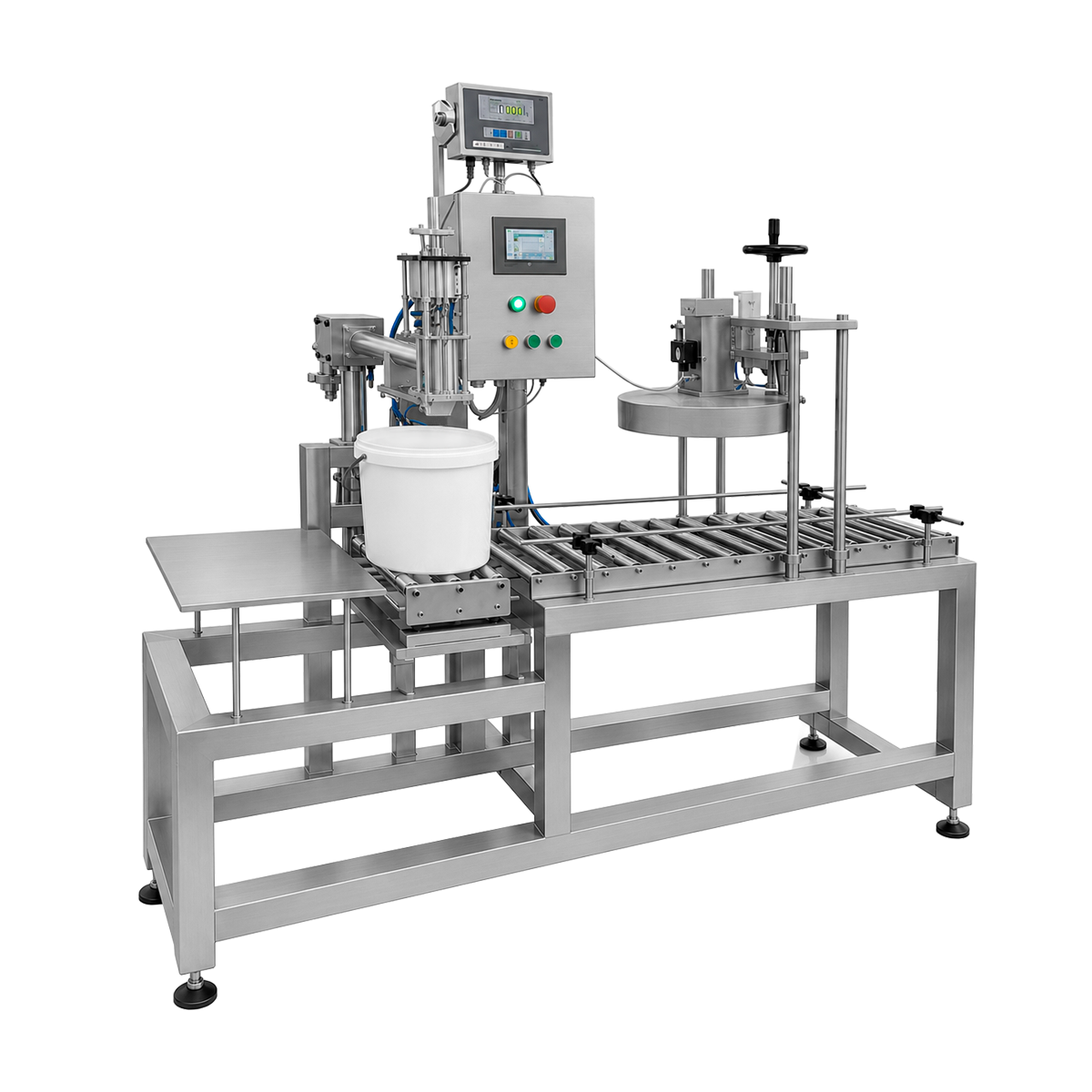
Semi-automatic bucket filling machines suit small production batches, product trials and businesses whose output does not justify fully automatic container handling. The operator positions each empty bucket, places the lid after filling and moves the pack through the machine. Dosing runs automatically, and machines with an integrated closing station also press the lid into place.
Our SATF-1 semi-automatic filling and lidding machine uses net-weight filling for liquid and viscous products. It is a practical option for producers packing yoghurt, sauces, spreads and similar products into tubs and larger pails. Output depends on the filling cycle and how quickly the operator handles each pack.
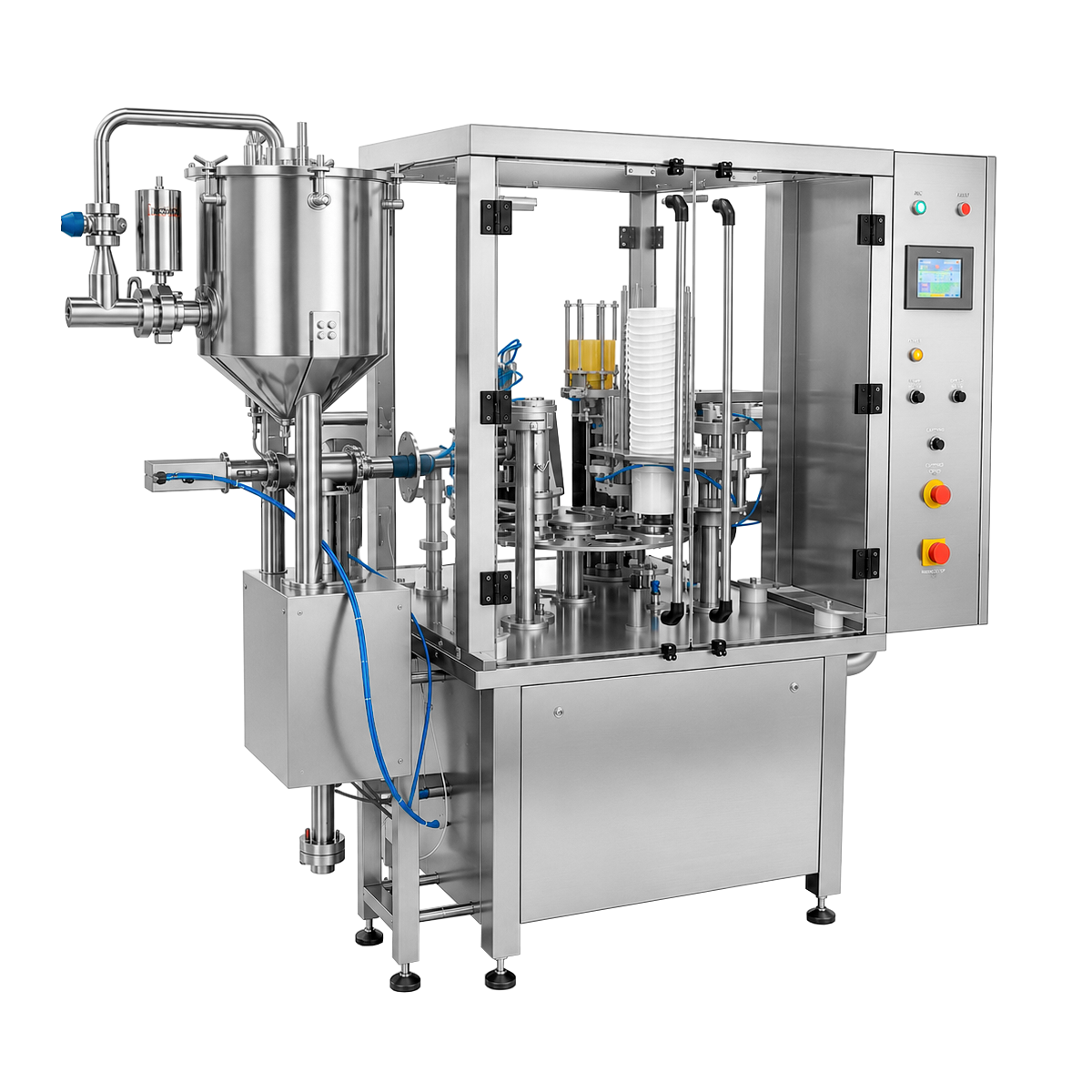
Automatic rotary bucket filling machines carry containers around an indexing table, which stops at each station for filling and lid application. The machine feeds empty buckets from a magazine, fills them, places and closes the lids, and discharges the finished packs. All of these operations fit within a compact footprint.
Rotary systems suit manufacturers who need automatic handling of pre-made tubs and pails within a defined format range. The dosing system and station layout depend on the product and the closure. Our range includes the RTF-1, which is available with several dosing configurations and optional sealing. It also includes the RTF-2, which handles fill volumes up to 2 litres by splitting each fill between two piston filling stations in sequence.
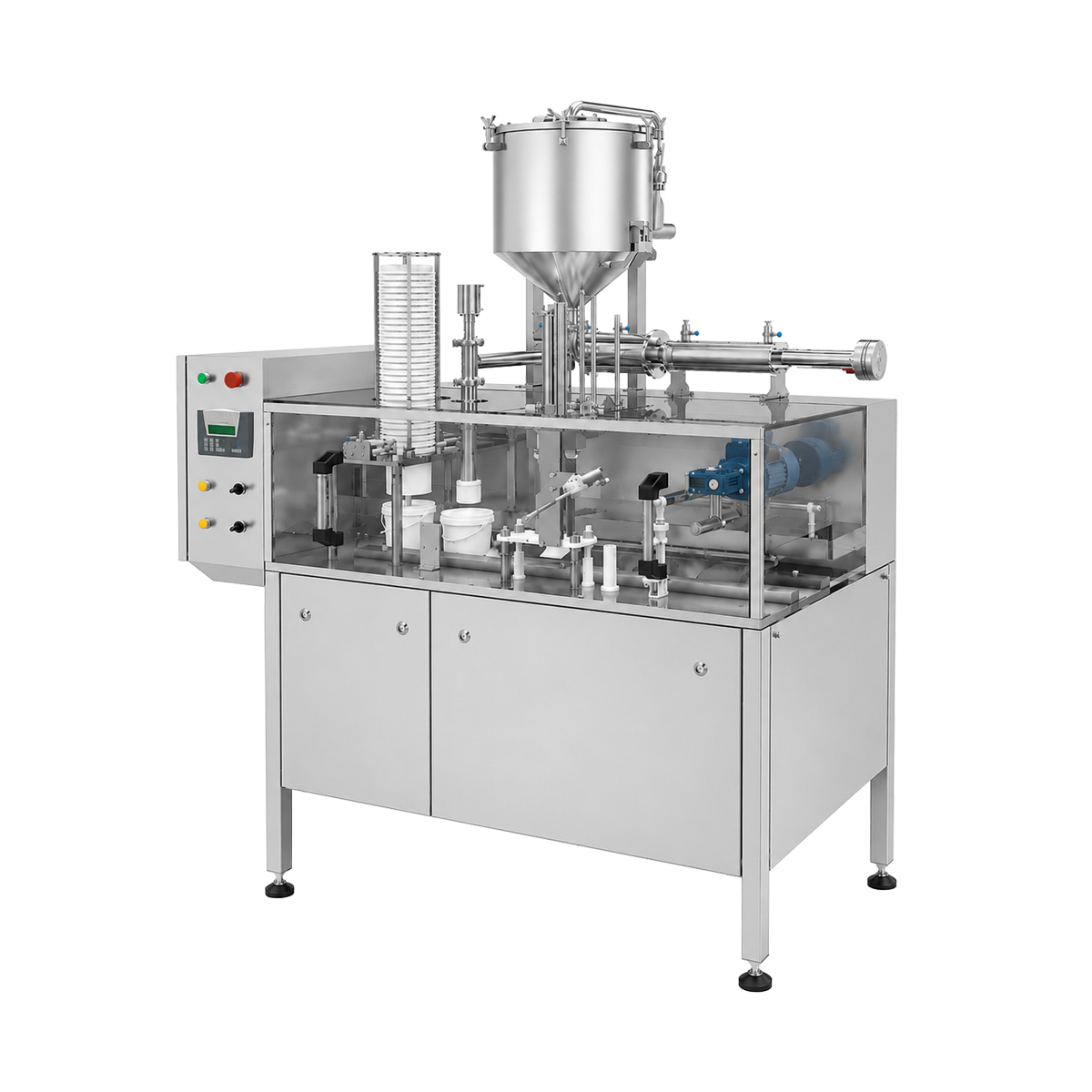
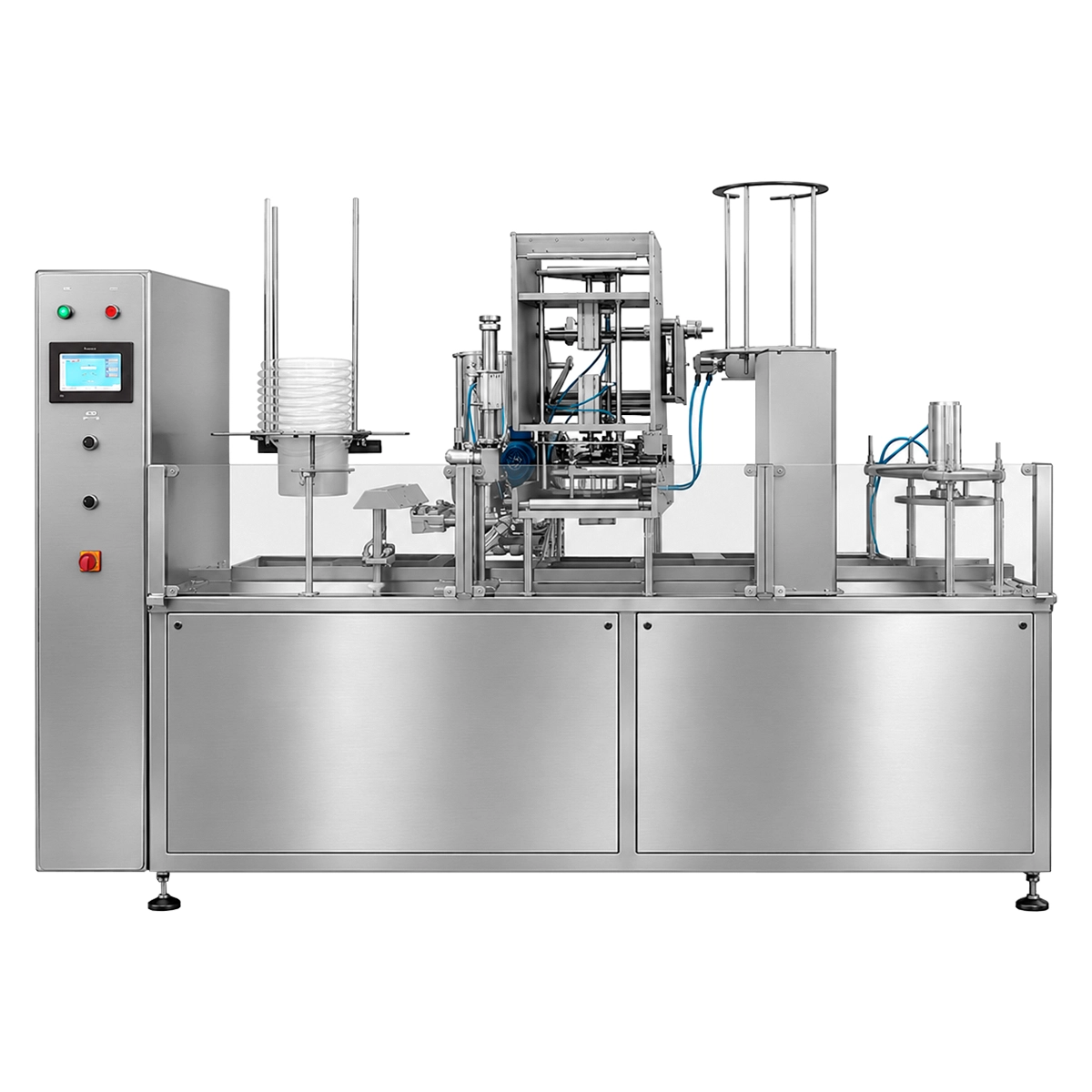
Automatic linear bucket filling machines move containers step by step through stations arranged in a straight line. Buckets arrive from a magazine or an infeed conveyor, depending on the configuration. The machine positions each container for dosing, sealing where required, and plastic lid application, then discharges it.
The range covers compact filling and lidding systems such as the LTF-1. It also covers larger-format systems such as the LTFS-2, which heat seals film onto the container before applying the plastic lid. Linear machines can handle both retail tubs and foodservice pails, and the pack size, operations and output you need determine the configuration.
The table compares container handling and packaging operations across the three machine types. Semi-automatic, rotary and linear describe the level of automation and machine layout; the dosing method depends on the product and filling requirements.
| CRITERION | SEMI-AUTOMATIC | AUTOMATIC ROTARY | AUTOMATIC LINEAR |
|---|---|---|---|
| Container movement | Manual transfer between stations | Automatic rotary indexing | Automatic linear indexing |
| Bucket feeding and positioning | Manual | Automatic from a magazine | Automatic from a magazine or infeed conveyor |
| Dosing | Automatic | Automatic | Automatic |
| Plastic lid placement | Manual | Automatic | Automatic |
| Plastic lid closing | Automatic with an integrated closing station | Automatic | Automatic |
| Heat sealing | Optional on selected configurations | Optional on selected configurations | Included or optional, depending on the model |
| Pack discharge | Manual removal | Automatic | Automatic |
| Operator involvement | Handles each container and lid | Replenishes packaging, monitors production and checks packs | Replenishes packaging, monitors production and checks packs |
Start with the product, the pack and the output you need. State whether the product is liquid, viscous or dry, and give its viscosity, filling temperature and any particles. Then list every container in the range, the filling quantities, and whether the pack needs only a plastic lid or also a heat-sealed membrane beneath it.
Each group of requirements settles a different part of the specification:
Cleaning and allergen requirements apply to every option, so include them in the specification from the start.
Typical applications include yoghurt, cream cheese, mayonnaise, sauces, honey, spreads and bakery fillings. They also include non-food products such as cosmetic creams. With suitable dosing equipment, the RTF-1, LTF-1 and LTFS-2 can also fill powders and granular products.
The dosing system must suit the product’s physical form. Powders do not flow like liquids, so a dosing system designed for liquid and viscous products cannot handle them. Across our range, auger fillers dose powders. Volumetric cup fillers or weigh fillers dose granular products.
Yes, within an agreed operating range. Each model covers a defined filling-volume range and handles round, square or rectangular containers. Format parts made to the customer’s container drawings adapt the machine to each tub or pail.
Specify every container before choosing a machine. Include its dimensions, rim profile, handles, lid design and filling quantity. Two pails with the same nominal volume can differ in diameter, height, wall taper and rim, and each difference can require its own format parts. If the pack has a heat-sealed membrane, the sealing tool must also match each rim shape. Send drawings and samples of every container and lid.
The main difference is the container path. A rotary machine carries buckets around an indexing table. A linear machine moves them step by step along a straight row of stations. Both layouts can automate container feeding, filling, membrane sealing and lid application.
The path affects how easily a machine can take on extra operations. A rotary table has a fixed number of index positions, so optional operations such as membrane sealing need positions planned into the design. On a linear machine, each extra station makes the machine longer. Neither layout is automatically more compact, because the footprint also depends on container size and the number of stations. Compare actual dimensions, format ranges and station layouts. The layout alone also does not tell you which machine will produce more finished packs.
For liquid and viscous products, the options are volumetric piston filling or net-weight filling, depending on the machine. Liquids can also use flowmeter filling. Dry products use auger, volumetric cup or weigh fillers.
Yes, if the product feed and filling system are suitable. For products such as fruit yoghurt, sauces with vegetable pieces and prepared salads, the particle size, concentration and fragility need to be assessed.
The pump, valves and filling nozzle must let the largest particles through without blocking and without crushing fragile pieces. The filling system is supplied from a balance tank. Particles that are denser or lighter than the surrounding product settle or float in that tank. In that case, the tank may need an agitator to keep the particle content the same from pack to pack. Trials with representative product samples confirm particle integrity, particle distribution and the appearance of the finished pack.
Yes, on suitable configurations. A sealing station heat seals a membrane onto the container rim, and the plastic lid goes on afterwards. The LTFS-2 includes heat sealing as standard. The SATF-1, RTF-1 and LTF-1 offer it as an option. Depending on the model, the machine either feeds pre-cut aluminium or laminated membranes, or cuts the membrane from a roll of film.
The two closures do different jobs. The membrane seals the container and shows whether it has been opened. The plastic lid protects the membrane and lets the user reclose the pack. A reliable seal needs two things: a membrane with a heat-seal layer that suits the container material, and a clean, flat rim. Product on the sealing surface can prevent a complete seal, so filling must avoid drips and splashes on the rim.
Output depends on several factors:
On a semi-automatic machine, output also depends on how quickly the operator positions buckets, places lids and removes finished packs. For production planning, allow for cleaning, changeovers, packaging replenishment and stoppages. A machine’s maximum speed is not the number of saleable packs it will produce over a full shift.
On an automatic indexing machine, all stations work at the same time. The containers move forward only when the slowest operation has finished. So one long operation, such as dosing a large volume of viscous product, sets the pace for the whole machine. On the RTF-2, two piston fillers at consecutive stations each deliver half of the preset volume. This means neither filler has to dispense the full amount within one cycle.
The cleaning method depends on the product path and the machine configuration. Some components must be removed and cleaned by hand. The automatic machines can include a standalone cleaning-in-place (CIP) unit. This unit runs pre-programmed cycles that circulate cleaning solutions through the whole product path.
CIP only reaches the surfaces inside the closed product circuit. Container handling parts, lid equipment, sealing tools and external surfaces still need manual cleaning. Agree the cleaning procedure during specification, including product changeovers and allergen requirements. Check that every part the procedure covers can be reached or removed.
Yes. The automatic machines can run standalone or connect to other equipment, such as product feed pumps, outfeed conveyors, date coding, labelling and finished pack collection. On the semi-automatic SATF-1, the operator moves the containers. Integration therefore mainly concerns the product supply and downstream equipment such as labelling.
Define the product supply early. A feed pump selected for the product moves it from the upstream process or product tank to the machine. Before choosing the machine, check the following:
The project specification should also define the electrical, compressed-air and cleaning requirements for the whole installation.

A bucket filling operation can use one of four configurations: a semi-automatic filling machine, a semi-automatic filling and lidding machine, an automatic rotary machine…
Container shape and material, label type, application position, line speed and changeover all determine how a labelling machine is configured. Whether you’re planning a new packaging line or upgrading an existing one, our engineers will help you select the right labelling technology and configure it around your containers and labels.