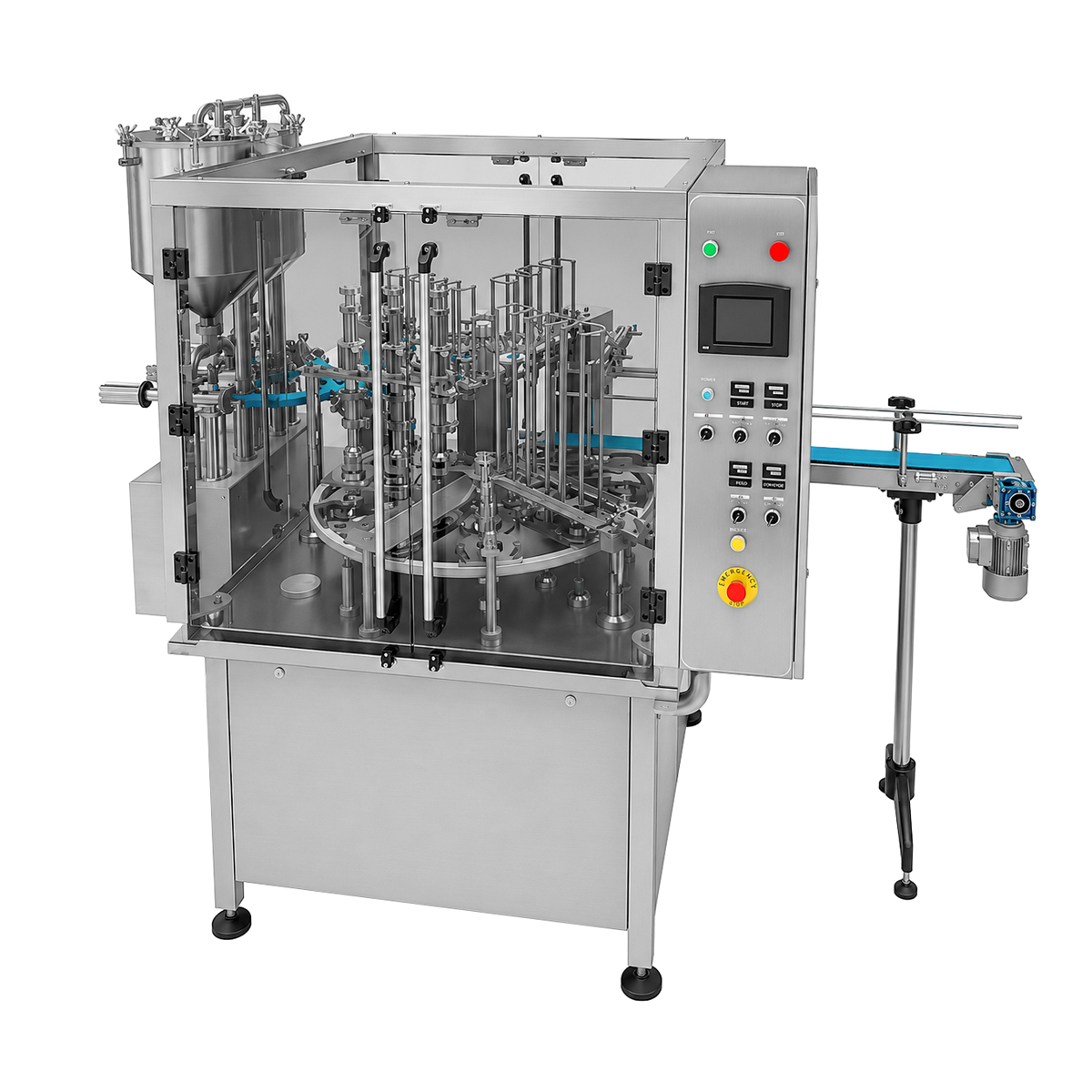
DESCRIPTION

The RCF-3 is a fully automatic three-lane cup filling and sealing machine designed to fill and seal pre-made plastic cups. It is suitable for a wide range of liquid and viscous food products, including set or stirred yoghurt, Greek yoghurt, sour cream, cream cheese, desserts and other similar food applications. Depending on the packaging specification, cups can be sealed with either pre-cut aluminium foil lids or pre-cut laminated plastic film lids.

The three-lane configuration makes the RCF-3 the highest-capacity model in our rotary cup filling machine range. Depending on the product and cup format, the machine is capable of filling up to 10 tonnes of product per production shift when operating with a 500 ml cup format. The machine can be configured for different cup formats, filling volumes and product characteristics, allowing it to accommodate a wide range of production requirements. Within a single integrated system, the RCF-3 performs the complete packaging cycle, including cup denesting, product filling, lid application, heat sealing and discharge of finished cups.

The machine is available in both Clean and Ultra-Clean versions and can be equipped with optional modules to meet specific packaging, hygiene and automation requirements.

TECHNICAL SPECIFICATIONS

Packaging type Pre-made cup/container
Product Liquid and viscous products
Filling volume 100–500 ml
Speed*, max. Up to 4,500 cups/hour
Packaging material PP, PS, barrier-coated paperboard
Lid material Aluminium foil/Laminated film
Compressed air consumption 1,200 l/min at 6 bar
Electrical supply 400 V, 50 Hz
Installed power 3 kW
Dimensions (L × W × H), max. 3000 × 2100 × 2400 mm
Weight, max. 1,000 kg

*Production speed depends on the filling volume, product characteristics, cup dimensions, and the quality and consistency of the packaging materials.

TYPICAL CUP PACKAGING EXAMPLES

OPERATING PRINCIPLE

The RCF-3 operates on an intermittent rotary indexing system. During each indexing cycle, the rotary turret transfers the cups to the next station, where a dedicated packaging operation is performed. Cup presence is verified before filling to prevent product loss, while optional stations such as UV treatment, secondary filling and plastic overcap application can be incorporated depending on the machine configuration. After the sealing cycle has been completed, finished cups are automatically discharged onto the outfeed conveyor for further handling or secondary packaging.

OPERATING SEQUENCE

STATION OPERATION
1 Cup denesting. Empty cups are automatically fed from the vertical cup magazine into the rotary turret cavities.
2 Cup detection and optional UV-C treatment. A photoelectric sensor verifies the presence of each cup before filling. If no cup is detected, the filling and sealing cycle is automatically skipped, preventing unnecessary product loss and packaging material consumption. An optional UV-C lamp may be installed at this station to reduce microbial contamination on the inner cup surface before filling.
3 Primary filling. A three-lane volumetric piston filling system is supplied as standard and simultaneously dispenses the preset product volume into three cups during each indexing cycle. The dosing system is suitable for a wide range of liquid and viscous products. Depending on the application, the station may be equipped with either a cup lifting mechanism or descending filling nozzles to minimise splashing of low-viscosity products or improve the distribution of highly viscous products within the cups.
4 (optional) Secondary filling. An additional filling station may be installed for layered or multi-component products requiring the simultaneous dosing of two components. Alternatively, the secondary station may be equipped with a different dosing system, allowing the appropriate filler to be used for each product without changing the machine configuration.
5 Lid placement. Pre-cut aluminium foil or laminated plastic lids are automatically picked from the magazine by vacuum suction and positioned onto the filled cups.
6 Heat sealing. The lids are heat sealed to the cups using controlled sealing temperature, pressure and dwell time to provide a consistent hermetic seal.
7 (optional) Plastic overcap application. Where required by the packaging specification, snap-on plastic overcaps are automatically fed from a vertical magazine, applied to the sealed cups and pressed securely into place.
8 Cup discharge. Finished cups are transferred onto the outfeed conveyor for optional date coding, inspection or secondary packaging.

OPERATOR RESPONSIBILITIES

The RCF-3 automatic cup filling machine requires minimal operator intervention during production. The operator is primarily responsible for supervising the machine and replenishing packaging materials. In most applications, product is automatically supplied to the balance tank by a feed pump controlled via a level sensor, ensuring a consistent product supply throughout the filling process. Typical operator responsibilities include:

  • Monitoring machine status, operating parameters and alarms via the touchscreen HMI.
  • Refilling the cup and lid magazines to maintain continuous production.
  • Verifying fill accuracy, seal integrity and overall pack quality through routine visual inspection.
  • Removing rejected packs, where applicable.
  • Performing routine cleaning, sanitisation and format changeovers in accordance with site SOPs and the production schedule.

OPTIONAL MODULES

EQUIPMENT DESCRIPTION
Product-Contact Parts in AISI 316L Filling system and all product-contact parts manufactured from AISI 316L stainless steel for improved hygiene and corrosion resistance.
Inkjet Date Coding Prints production dates, expiry dates, batch numbers and other variable information directly onto the finished package.
Product Feed Pump Automatically transfers product from the upstream process to the balance tank. Pump type is selected according to the product characteristics (e.g. centrifugal or lobe pump).
UV-C Cup Treatment Reduces microbial contamination on the inner cup surface before filling using UV-C irradiation.
Laminar Flow System with HEPA Filter Provides HEPA-filtered laminar airflow over the filling area as part of the Ultra-Clean machine configuration to reduce the risk of post-filling contamination.
Inert Gas Flushing System Flushes the package headspace with an inert gas (e.g. nitrogen) before sealing to reduce residual oxygen and support extended product shelf life.
Extended Outfeed Conveyor Provides additional space for product accumulation or integration with downstream packaging equipment.
Rotary Collection Table Accumulates finished packs for manual collection or transfer to secondary packaging operations.
Filling System for Products with Particles Modified filling system designed for products containing fruit pieces and other food particles.
Cup Lifting Mechanism Raises the cups towards the filling nozzles to improve product distribution and minimise splashing during filling.
Plastic Overcap Applicator Automatically applies and secures snap-on plastic overcaps after heat sealing.
Heated Balance Tank Maintains the required product temperature during filling of hot-filled or temperature-sensitive products.
Balance Tank Agitator / Auger Maintains product consistency and supports the transfer of highly viscous products into the filling system.
Stand-Alone CIP Unit Provides automatic cleaning of the complete product path using pre-programmed Cleaning-in-Place (CIP) cycles.
Contact experts for your packaging or filling project support

Request a Quotation