DESCRIPTION
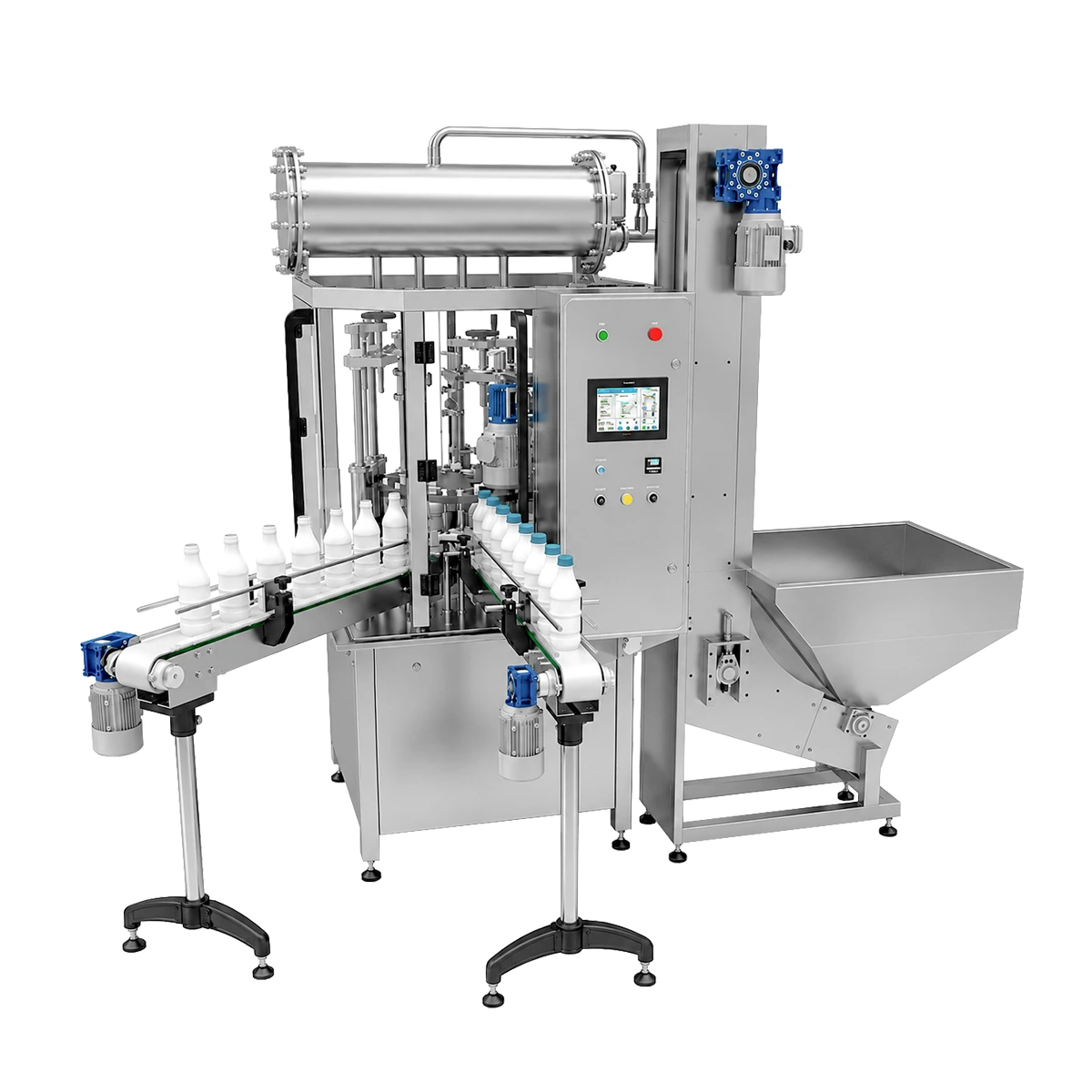
The BFCM is an automatic rotary bottle filling and capping monobloc designed for liquid and viscous food and non-food products in PET, HDPE and PP bottles. It is particularly well suited to dairy products and beverages, including milk, drinking yoghurt, kefir, ayran, juice and smoothies.
The BFCM uses two volumetric piston filling stations to accommodate different product viscosities and filling requirements. The filling nozzles enter the bottles during dosing to reduce foaming and splashing. The integrated cap feeding and placement unit supplies and positions plastic screw caps for the capping station.
The BFCM fills volumes from 250 to 1,000 ml at speeds of up to 1,000 bottles/hour. An optional bottle rinsing unit can rinse empty bottles with reverse osmosis (RO) or ozonated water before filling. The BFCM can operate as a standalone filling and capping machine or form part of a complete bottle packaging line.
OPERATING PRINCIPLE
The BFCM operates on an intermittent rotary indexing system. The indexing turret transfers the bottles through the detection, filling and capping stations, with each station performing a defined operation during the packaging cycle. Two volumetric piston fillers divide the preset product volume between two filling stages before the filled bottles move to the cap placement and capping stations.
OPERATOR RESPONSIBILITIES
The BFCM automatic bottle filling and capping monobloc requires limited operator intervention during production. The operator is primarily responsible for monitoring the machine, maintaining the supply of bottles and caps, and checking the filling and capping process. Typical operator responsibilities include:
TYPICAL APPLICATIONS
The BFCM can fill a wide range of liquid and viscous products using its standard volumetric piston filling system. Filling parameters and dosing configuration can be selected according to product viscosity, foaming behaviour and filling requirements.
CONFIGURATION OPTIONS
The BFCM can be configured according to the product, bottle format and production requirements. Optional equipment covers filling system upgrades, product supply and preparation, bottle handling, capping, hygiene and integration with upstream and downstream packaging equipment.